I connect bespoke interface design with data architecture, AI and device integrations. JavaScript, PHP, SQL and APIs become a single mechanism: the customer configures a product, the system prepares the quote, and the order sets the next steps in motion across your business. On screen, you see the standard of the craft. Underneath runs logic designed for your business.
I design API-first systems and event-driven workflows, from a transaction in a SQL database to a signal from a device. An example: reserving a house updates the CRM, the viewing calendar and the cash-inflow forecast. On the production floor, PLC data can feed OEE measurement, a downtime log and quality control. I match the architecture to the process, from a compact application to event queues and separate services.
Websites that set the standard
I design visual hierarchy, typography and the choreography of interaction: from precise micro-animations to generative graphics. Every detail leads to the next step. A hotel guest first wants to be in the room on screen; a moment later they are choosing their dates. An impression has an architecture of its own – just as a booking does.
semantic HTML · CSS Grid · JavaScript · SVG and Canvas · WebGPU · View Transitions API · Core Web Vitals: LCP, INP, CLS · WCAG 2.2 · JSON-LD
// the most important line on any website const goal = "enquiry from a customer"; site.design({ goal, mobile: true, seo: true });
launch pages
company websites
knowledge and SEO
language versions
From choice to finished quote
I build CPQ configurators: Configure, Price, Quote – rule engines that link product variant, price and quote. A joinery customer sets the dimensions of a fitted unit, sees the design and learns the cost. For a residential developer, I design the link between quantity take-offs, materials and budget: change an assumption and the system shows which items need recalculating.
CPQ rule engines · SVG and Canvas · BIM/IFC quantity take-offs · supplier APIs · JSON and CSV price lists · server-side calculation · PDF quotes
Apps for work beyond the office
I design PWAs with local storage and data synchronisation. A fitter records measurements on site with no signal; once the connection returns, the app passes them to the office. I match notifications, installation and the scope of offline work to the target devices.
Service Worker · IndexedDB · Cache API · Web App Manifest · Web Push · sync queue · data conflict handling
Your whole business logic in one system
I build CRM, ERP/WMS modules and LLM assistants with RAG search across company documents. I connect case workflows with SQL databases, data warehouses and reporting. A salesperson checks what was agreed with the customer, the warehouse receives a picking task, and the owner sees the margin after purchase and delivery costs. AI can read a document, cite the source of its answer and prepare the next action for approval.
PHP 8 · PDO and prepared statements · MySQL/MariaDB · indexes and transactions · REST API · RBAC · RAG and hybrid search · ETL · WebSockets · audit logs
CRM
ERP and WMS
AI assistants
client portal
margins and data
A system that reaches beyond the screen
I connect software to devices through APIs, industrial protocols and IoT gateways. Access control issues a crew a temporary PIN, an ANPR camera checks a vehicle’s number plate, and a sensor reports rising temperature in a cold room. I also design image analytics: people counting, footfall heatmaps and detection of defined events. In a shop, you see which display holds customers longest.
REST and webhooks · MQTT · OPC UA · Modbus · PLC/SCADA/MES integrations · edge AI · ANPR · RFID/NFC · OCPP · payment, KSeF e-invoicing and logistics APIs
Expertise that gets found
I design information architecture and semantic data for search engines and AI systems. I pair technical SEO with content that answers specific questions. Someone is looking for a heat pump installer nearby: on your site they learn the scope, understand the process and know what to ask.
I build a design system: tokens, typography and components for web, app, email and print. A customer opens your quote on their phone, later picks up a business card finished in spot UV – and recognises the same care for proportion, rhythm and detail.
design tokens · component library · SVG · HTML email and inline CSS · CMYK PDF · bleeds · spot UV mask
finely detailed print
brand email
campaigns
offer launches
A project I stand behind
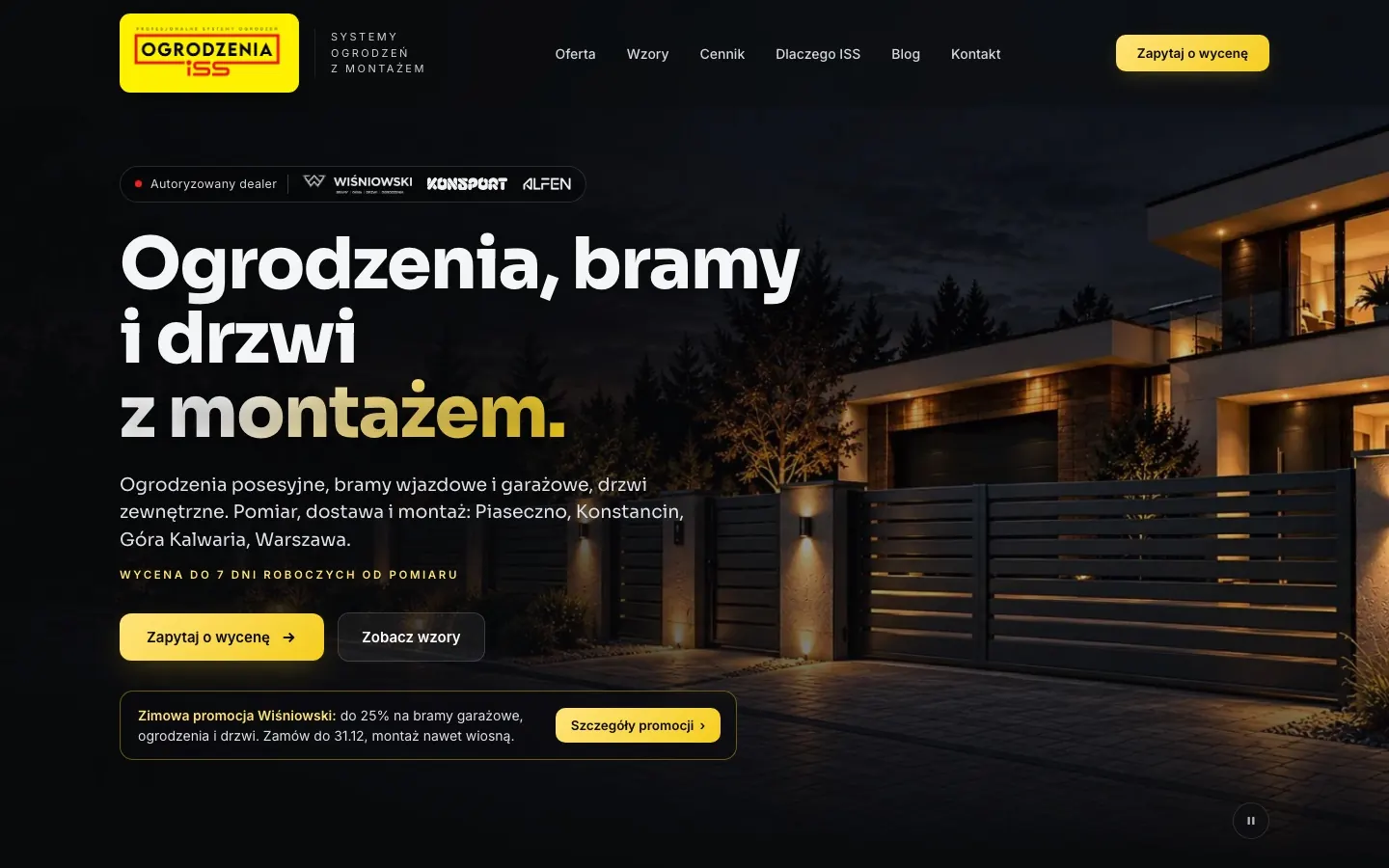
Ogrodzenia ISS. From industry knowledge to a system of my own.
Fences, gates and doors – and the software I designed for the company I co-own. I develop the website, the planner with its cost estimate, the PWA dashboard and the customer accounts as a single whole. Here the commercial perspective meets decisions written in code. See: iss-ogrodzenia.pl ↗
iss-ogrodzenia.pl
<section class="hero"> …
Ogrodzenia ISS home page
illustrative mock-up
104 pages and 37 guides build the context for a fencing decision. The site lets visitors understand the subject first, then move on to planning their own installation.
104 pages making up the company website
37 guides exploring how to choose a fence
Product range and industry knowledge within one site
Content grounded in the practice of selling fences, gates and doors
HTML/CSS/JSlocal SEOSchema.orgWebP
The planner ties the fence configuration to a cost estimate built from the manufacturer’s price list. Product choice gains a financial dimension: the customer can see what drives the costing of their project.
Fence configuration linked to cost calculation
Project parameters as the starting point for a quote
Cost estimate based on 4,588 items in the manufacturer’s price list
Price list refreshed automatically once a week
Plan and cost estimate as the basis for discussing the installation
JavaScriptSVGPHPCRONJSON
The PWA dashboard and customer accounts form the other side of the system. Behind the public offer sits a back office built for the company and its customers.
Account access through a link sent by email
Individual customer accounts in the ISS system
Company dashboard delivered as a PWA
Website, planner and account management in one project
PHP 8MySQLPWAAPI
I treated the business cards and correspondence as part of the project too. The brand reaches the customer on screen, in the inbox and in print.
Business cards designed with a spot UV finish in mind
12 variants of the company email signature
Print materials tied to the company’s presentation
Correspondence brought within the brand identity
PrintE-mail HTMLLandingStrategy
// iss_project.stats() the scale of the build and how the project is assessed
4588items in the configurator price listthe price follows from manufacturer dataprice list updated automatically every week
104pages on the ISS websitethe offer developed into an extensive industry websiteincluding 37 guides
7project review areasthe framework for my pre-launch reviewfeatures · data · security · UX · accessibility · performance · SEO
42,660lines of code in the ISS systema bespoke implementation for a specific businesswebsite · planner · PWA dashboard · customer accounts
Demo
Push the project’s limits. Watch the code respond.
The configurator turns parameters into a drawing and calculations. Widen the gate, shift its position, add a pedestrian gate. Watch a single decision change the whole layout. This is a simplified demonstration of the solution used at ISS.
fence-planner.demo · street viewlive
–panels
–posts
–m of fencing
–m for the gate to slide
Product rules become something the customer can check for themselves. In this demo I assume a maximum panel span of 2.5 m and an indicative gate slide zone of 1.5 times the entrance width. It is an illustrative model; a real project needs the parameters of the chosen system. The full ISS planner draws on the manufacturer’s price list. For your industry I design dependencies of your own: from fitted kitchens to finish options for a house.
Show me the product, the options and how the price is calculated. I’ll turn them into a configurator for your customers.
I built an app for managing your cars, with an AI assistant and document reading. PHP 8, MySQL, PWA and Web Push form its back end. It shows how information held in documents can be joined to an interface built for daily use. I can design a similar architecture for a fleet, a machinery register or a company document workflow.
A specialist’s website · knowledge and sensitivity
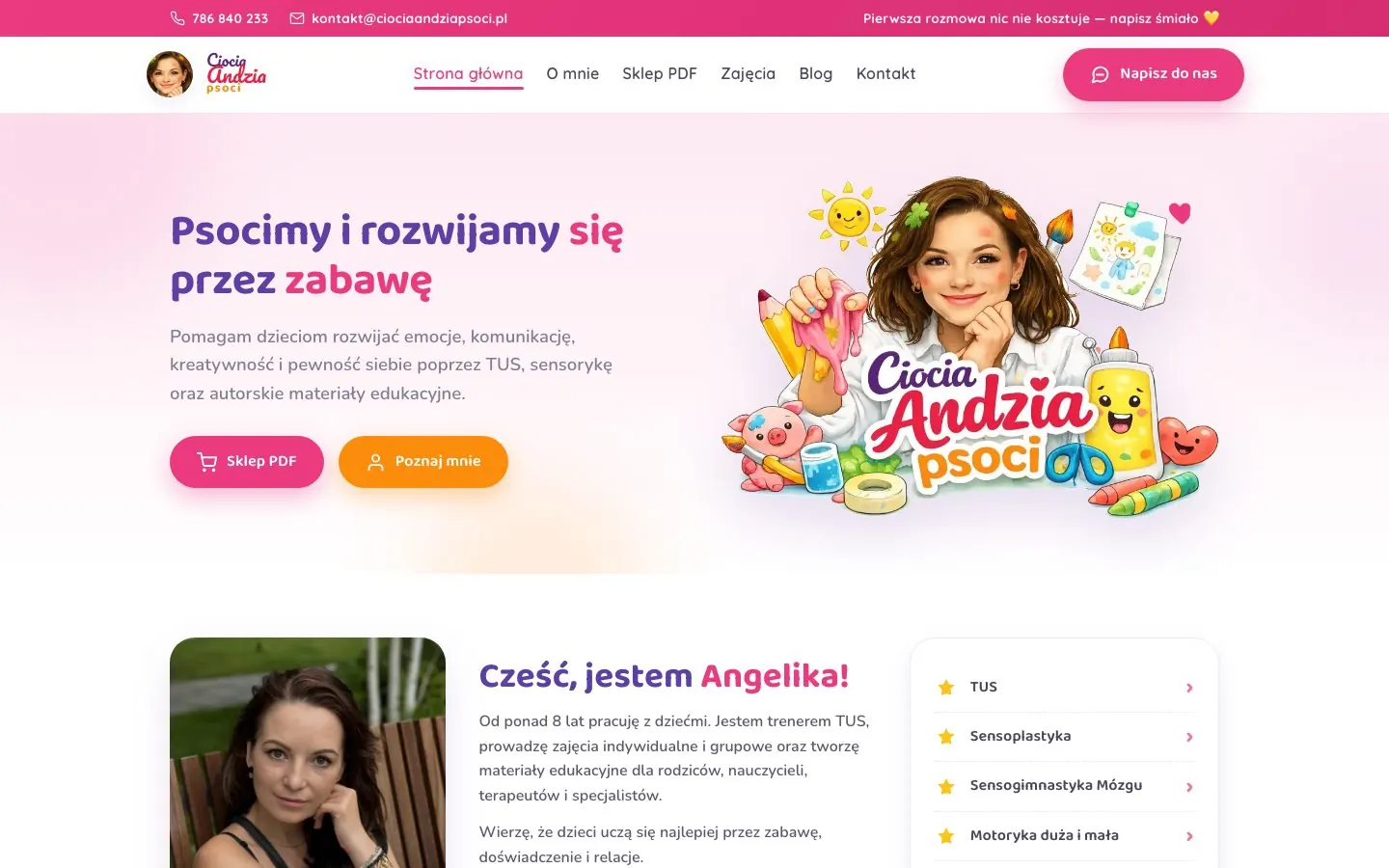
Ciocia Andzia psoci. Trust begins with understanding.
I built the website of a therapist who works with children around her specialism. The site comprises 38 pages and 21 articles. In a field like this, the way knowledge is presented is part of the experience: a parent should be able to explore the subject calmly, find the information they need and take the next step.
38 pages making up the therapist’s website
21 articles expanding on the site’s themes
A project devoted to working with children and their needs
Knowledge as the starting point for getting to know the specialist
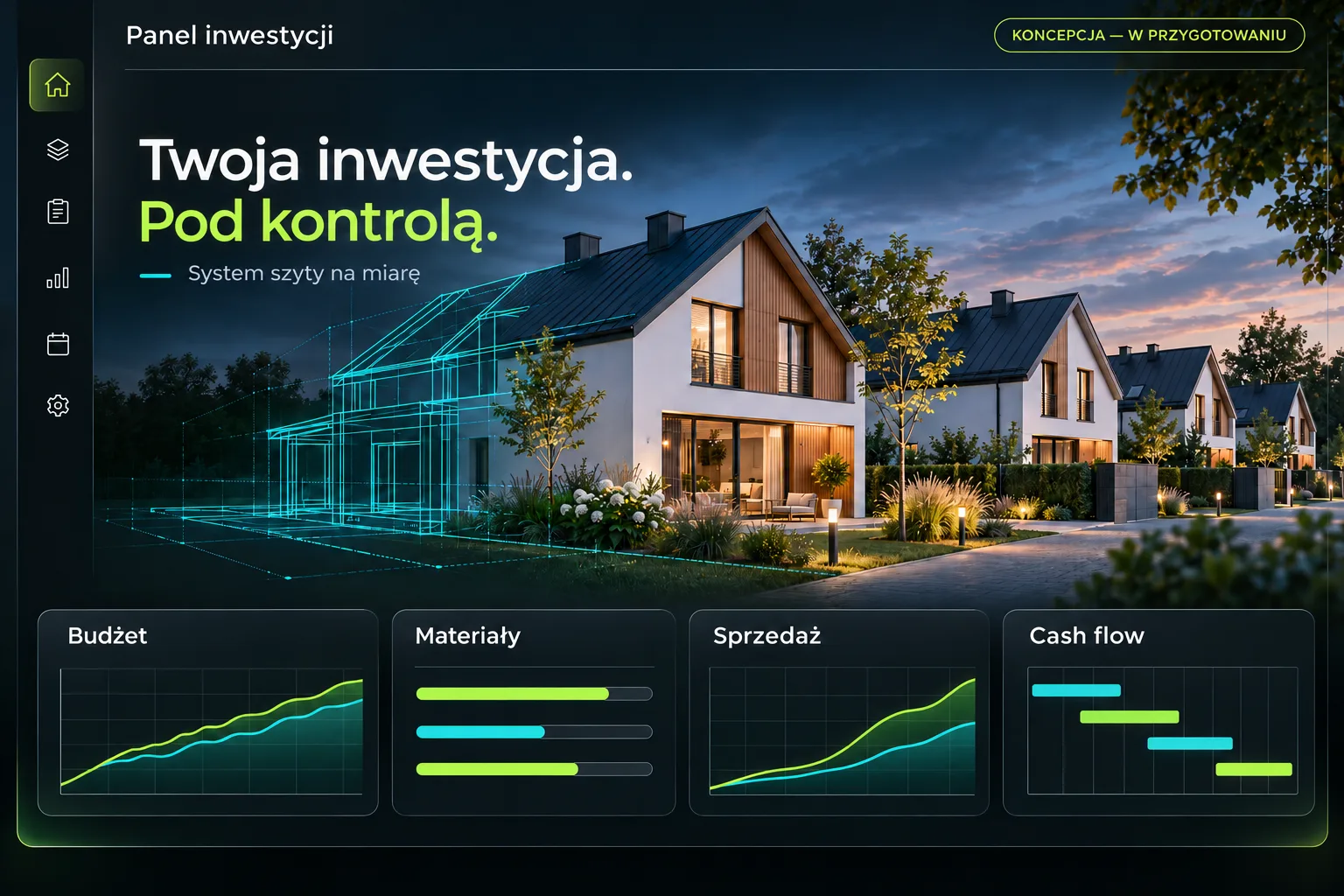
I design applications for firms building houses, semi-detached homes and small estates. I bring project cost control, quantity take-offs, procurement, the construction programme and sales CRM into one data model. In practice: you check what a given house should cost, what you have already ordered, when you need the money and how the next change affects the forecast result. The system is built around your developments, your way of costing and your way of working.
Budget and margin. I build project cost control with a forecast of final cost – Estimate at Completion – and of cash flows.
Design and materials. I link BIM/IFC quantity take-offs, design schedules and supplier price lists to costing rules.
Construction and procurement. I design a dependency-based programme, a change register and a procurement workflow tied to the budget.
Sales and the buyer. I connect a house builder’s sales CRM with plot availability, email, calendar and a buyer portal.
For property flippers and investors · example system
Run the numbers before you buy.
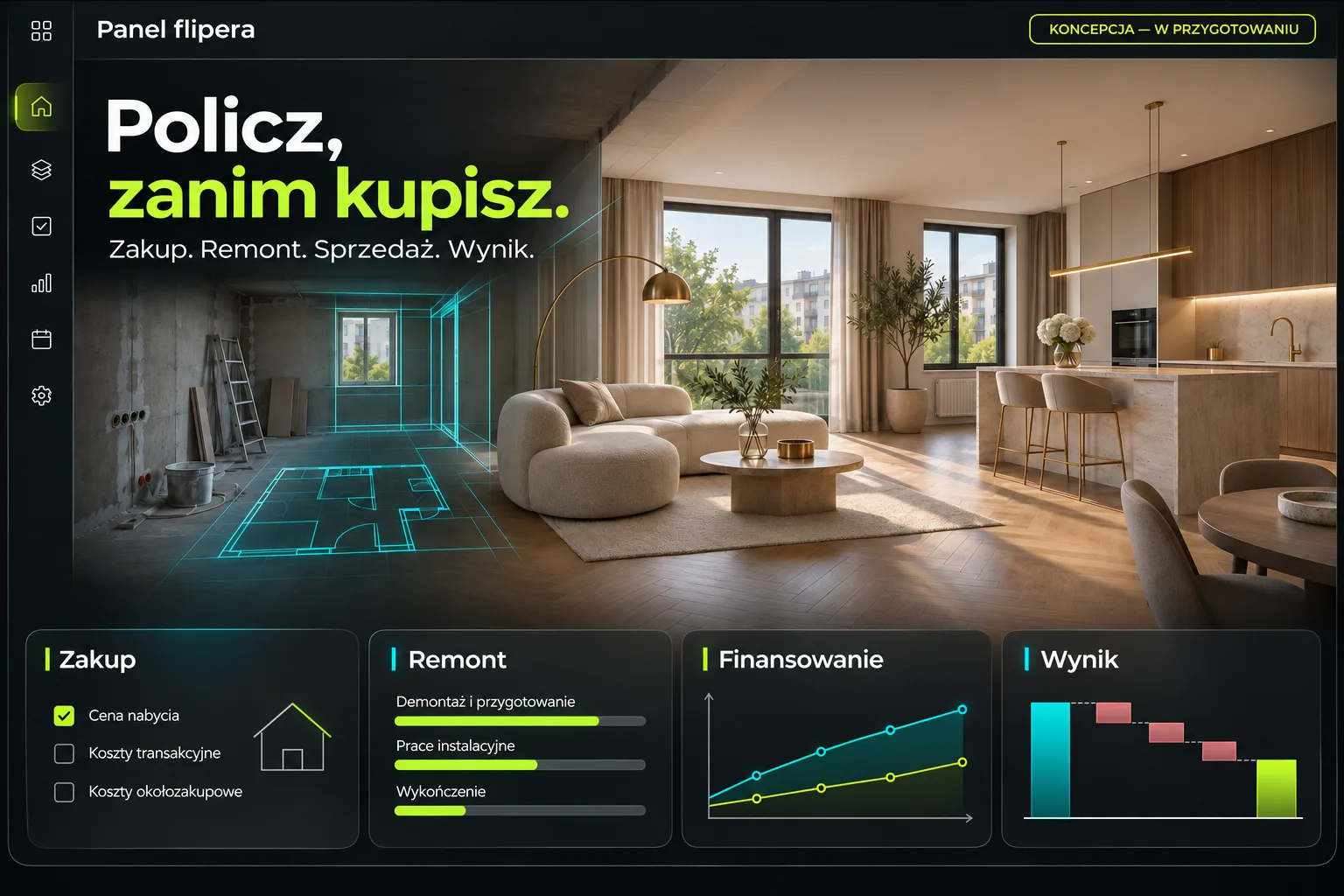
I design a system that brings purchase analysis, the refurbishment budget, financing and the sale into a single investment calculation. The purchase price is only the beginning. You want to know how much capital you will tie up, what a delay does to the result, and at what sale price the project still meets your assumptions. I build those answers from data you can verify.
Purchase analysis. I build comparable-property analysis that separates asking prices from transaction prices.
Refurbishment and trades. I design the refurbishment cost estimate and job accounting by room, trade and stage.
Result and financing. I build a cash-flow model and a sensitivity analysis of the result.
Sale and portfolio. I connect the sales CRM with the viewing calendar, documents and results across the whole portfolio.
RCN and WFSmapscomparables analysisscenarioscalculation rules
Your business has its own logic. Your app can too.
I design software around how you earn, make decisions and deliver work. Every industry asks different questions – and those questions are where I start. All industries →
Konrad Lewandowskifull-stack · architecture · UX · SEO
LOCATIONPoland + abroad
MODEremote · video and phone
STATUS● taking on projects
SIGNATUREhand-written code
About the author
Konrad Lewandowski. One author. The full picture.
As co-owner of Ogrodzenia ISS, I see a business through its offer, its customer and the buying decision. As a full-stack developer, I translate those relationships into software architecture. I designed the entire ISS system and develop it on my own. I bring the data model, interface, configurator, PWA dashboard and automations together in one project. I work remotely, for companies in Poland and beyond.
You talk to the person who makes the design decisions and writes them into code. I lead information architecture, UX, implementation, testing and deployment. I can move from the proportions of a heading to a database transaction, then connect the application to an external system. I translate a vision into dependencies that can be built, tested and extended. The code, the domain and the access credentials belong to you.
websites and SEOapps and PWAsconfiguratorsdashboards and databasesprint and branding
This site is also a sample of how I work: my own code, calculations performed in the browser and a deliberate decision behind every element. Below: how it is built, and the principles I follow in projects.
runtime0 frameworks, 0 dependencies
The interface of this site is implemented in my own JavaScript. I limit the number of dependencies whose changes have to be tracked during maintenance.
transfer1 HTML document, about 50 kB
About 50 kB after compression covers the HTML document with its styles and scripts. Images and fonts are separate resources.
securityCSP · HSTS · resource control
I design protection in layers. CSP defines the permitted sources of resources, and HSTS instructs the browser to use HTTPS. Each mechanism has its own job.
privacyown analytics, your choice
I run my own visitor analytics. Returning-browser recognition starts with your permission. You can change your choice in Cookie settings.
backendvalidation · permissions · limits
The server checks the rules independently of the interface. I design validation, access control and rate limits – including for requests sent outside the form.
3D renderJavaScript · geometry in motion
The 3D sphere is computed in JavaScript. A three-dimensional object on a flat screen emerges from mathematics you can watch in motion.
i18n3 languages from one source
A single project base feeds the PL, EN and ES versions. It is a way of organising content that helps keep a shared structure as the site grows.
graphicsparameters · calculations · geometry
I design graphics tied to product rules. The customer changes a dimension, and the drawing shows the result of the same decision that feeds the costing.
a11yWCAG 2.2 · semantics · keyboard
Accessibility is built into the structure of the interface. I check contrast, focus visibility and keyboard operation, among other things; motion follows the user’s preferences.
mediaWebP · srcset · performance budget
I design how images are delivered to different screens. A phone receives the appropriate image variant, and resources below the fold can load later.
deployversions · monitoring · recovery
I design deployment together with change and incident handling. That covers versioning, monitoring in operation and an agreed route back to a working version.
PWAISS dashboard · KLakson
I used PWA technology in the ISS dashboard and the KLakson app. This model makes it possible to deliver company tools through web technologies.
Stages of work
Six stages. Each with a concrete outcome.
I lead the project through decisions you can assess: scope, prototype, features and acceptance criteria. You know what you are approving and where the next stage leads.
01
Analysis
I map the processes, the audiences and the points where work stalls. I establish what the customer should see and what should happen in the business afterwards.
02
Plan
I set out the modules, data, integrations and order of delivery. You receive a plan and a quote in writing. For AI and devices, I also define the scope of a technical trial: what we will test on your data and hardware before building the whole.
03
Prototype
I prepare a prototype to test on phone and desktop. You walk the user’s path, from the first view to completing a specific task.
04
Code and verification
I implement the logic and integrations, and base the tests on operating scenarios: a correct quote, a retried payment event, loss of network, an access attempt without permission. I evaluate AI models on agreed examples, and hardware integrations on the target set of devices.
05
Acceptance and launch
Together we check the acceptance criteria. I bring up the agreed environment, configure the necessary services and hand over the code, access credentials and a user guide. Going live should be the start of orderly work with the system.
06
Growth
I analyse feature usage, errors and new needs, and plan further development on that basis; the scope of ongoing care is agreed individually.
The practicalities
Specifics before you decide
What will the project and its quote cover?
Before work begins, you receive the scope, deliverables and quote in writing. I define the modules, integrations, acceptance criteria and supplier dependencies. Agreed third-party services, licences and ongoing care are itemised separately. The payment schedule is agreed individually. Any extension of scope is agreed first, together with its effect on cost and timeline.
When will it be ready?
The timeline follows from the scope and the project’s real dependencies. For a device integration I check its interface; for AI, the quality of the data. The schedule allows for the prototype, any pilot and acceptance, as well as the materials and access needed from your side.
How do you secure my rights to the project?
The code, the domain and the access credentials belong to you. The transfer of economic copyright in the works covered by the contract is set out in a written agreement, specifying the fields of exploitation and the moment the rights pass. Third-party components remain subject to their stated licences.
Will I be able to move to another developer?
I prepare the project so that a competent developer can maintain it. I hand over the code, access credentials and the agreed documentation, and describe the dependencies and third-party services. The next developer has what they need to understand the architecture, rebuild the environment and continue the work.
Can you connect the system to my hardware?
I match the integration to the device model and its interface. An API, SDK or gateway connects the application to access control, cameras, automation or point-of-sale equipment. An example: a booking issues a temporary PIN for a holiday cabin, and the end of the stay revokes access. I verify compatibility before deployment.
Can AI work with my company’s knowledge?
I build RAG and agents with a defined scope of permissions. An employee asks about a clause in a contract and gets an answer with its source; a school can offer explanations of its own materials, and a practice can organise its administrative documents. We set approval rules for any action that changes data or sends messages.
How do you protect data in the system?
Data protection is built in from the design stage – privacy by design. We establish the purposes of processing, permissions, retention, suppliers and each party’s obligations. I select encryption, RBAC, audit logs and authentication, including passkeys/WebAuthn. The scope of documentation and any legal review is agreed before work begins.
What happens after launch?
I match the scope of maintenance to how much the system matters to your business. It can include monitoring, updates, backups and restore tests. For critical processes I design for high availability and agree RTO/RPO targets: the time to restore service and the acceptable data loss.
Does the app work on a phone?
I design PWAs for specific tasks and devices. A PWA can handle jobs, measurements, bookings or warehouse work, with installation, selected offline features and Web Push. Availability of these features depends on the operating system and browser. Where deeper integration with the phone is needed, I assess the case for a native solution.
Project outline
Choose the capabilities. Let’s start with what you need.
Set the direction, features and timeline. The builder turns them into a message you can complete with the detail that matters most: what this project should change in your business.
01 / WHAT YOU NEED
02 / WHAT IT SHOULD DO
03 / WHEN
04 / WHAT YOU ALREADY HAVE
Contact
What takes too much work today? Let’s design it differently.
Describe the product, the process or the idea you have in mind. It might be a website that turns heads, the profitability of every house on an estate, or a system that works with machines. I reply personally within 3 working days, and we can talk in English or Polish. After our conversation you receive a plan and a quote in writing.
Iteration and cellular automata turn mathematics into moving images. The browser becomes a laboratory: pick a point or draw a pattern and watch the consequences unfold.
computed live
Click the image to zoom in. The closer to the edge of the black shape, the more there is to see.
What is this about?
It is a map of one simple calculation, repeated over and over. For every point of the image the computer takes a number, squares it, adds the position of that point and does the same again with the result: dozens or hundreds of times.
If the result grows without limit, the point gets a colour. Far from the shape it escapes quickly and the point is turquoise; right at the edge it takes a long time and glows violet or pink. If the result never escapes, the point stays black. That black shape is the Mandelbrot set.
The most interesting part is the border between black and colour. Click on it and you will find swirls, spirals and miniature copies of the whole shape. Keep zooming and there are new details every time. An image like this is called a fractal.
Why does a programmer care? It is the classic demonstration of how one line of formula produces endless complexity, and a test of raw computing speed at the same time. This image is several hundred thousand points, each calculated separately in a fraction of a second. The numbers below the image show the position, the magnification, the number of repetitions and the time it took.
Why does the zoom eventually run out? A computer stores numbers to about 16 digits. At magnifications in the trillions, neighbouring points can no longer be told apart and the picture breaks into squares.
Draw with your mouse or finger and watch what grows.
What is this about?
It is a simulation, not a game you win. The board is a grid of squares. Each square is alive (lit) or dead (dark).
Every moment the whole board takes one step. Each square counts the live neighbours among the eight squares around it and applies two rules. A live square survives with two or three live neighbours: with fewer it dies of loneliness, with more of overcrowding. A dead square comes alive with exactly three.
That is all. Nobody steers the movement, yet shapes appear that stand still, pulse or travel. The small travelling pattern of five squares is a “glider”. The “Gosper glider gun” you see at the start fires a new glider every 30 steps.
Try it yourself: draw a few squares and see whether the pattern dies out, freezes or takes on a life of its own. “Random pattern” seeds the board at random and “Pause” stops time.
Why does a programmer care? The game was devised in 1970 by the mathematician John Conway. It has been proved that gliders and guns can be combined into logic gates, and those into a working computer. It is the simplest known example of complex behaviour emerging from a few trivial rules, which is exactly what happens in a well-designed system.
The side door
Step into the console.
Type help. Discover a second way to move around this site.